Friday, April 02, 2010


 This morning I heard about the new draft pick for the lowest ranked team in Major League Baseball, the Washington Nationals. I don't know much about sports, but apparently, they got the best pick of the season - 1st round pick or something like that. The funny thing was that though they are the lowest ranked team with 100 straight losses (whereas the Yankees have at least 9 players with $150 million dollar contracts and have won the world series at least 4 times in the last 10 or 15 years) they chose to put the highest ranked rookie of the season down into their junior team. You'd think they'd want to pull him into the Major League as soon as they got him. Not so in baseball. Baseball is a sport that you need time to play into. Apparently the fear is that if a high ranked rookie goes straight to the Majors, he could get eaten up and overwhelmed with the level of play and professional intensity.
 Though he has the talent, he does not have the maturity and needed experience to play in the Majors yet. The teams decision reflects their hard earned wisdom - that no matter how good a rookie is, he needs to play at a level that gives him an increased sense of confidence and experience before he's launched out into the big leagues. This matures him as well as giving him an honest appraisal of what he's got himself into. The concern in sending him into the malaise of the Big Leagues is that if its done to soon too fast, he won't last and a great career could come to a halting crash as a result. By starting the super star in a league below the Majors, he builds confidence, gets experience, and matures into a position and an ability that matches the intense environment of the Majors - thereby extending his life in the Majors as well as procuring a matured playing style that will give him success in the long run rather than in the short run.
Anxiety can take place in the lives of people going through this process and cause them to shortchange themselves and everyone else. This reminds me of the horses at Arlington Race Track. As they stand in the gate, ready to launch out, waiting for the gun to fire and the gate to fly open, they anticipate the launch. So much, though, has been put into their preparation for their first race. Many teenagers and young adults feel this same anticipation, this same longing to launch out into the world and make an impact. Many of us want responsibility before we are entrusted with the authority that comes with time or we want authority without fulfilling the responsibility that accompanies the authority. The time that is required to go through this process of waiting is difficult.
It has been said "Waiting is the hardest work of hope." -Smedes ( I believe ).
In the New Testament, Peter points out, "Young men, in the same way be submissive to those who are older. All of you, clothe yourselves with humility toward one another, because, 'God opposes the proud but gives grace to the humble.' Humble yourselves, therefore, under God's mighty hand, that he may lift you up in due time. Cast all your anxiety on him because he cares for you."
God cares about the anxiety involved in the process of waiting that we are going through. In due time we will be given the responsibility and authority to lead others into an ongoing and responsible encounter with God. We don't have to be "professional Christians" to do this, we simply need to pursue maturity in Christ and wait for God's timing. What do we do in the meantime - play in the juniors, practice in the off season, be submissive to those who are older and practice acts of humility ( that's what helps one to become humble, because we aren't naturally ). Whatever strengths you have as a leader will come out and benefit the people that you lead immensely. Whatever insecurities you have will come out and have the potential of harming the people that you lead, but they don't have to. In a forthcoming post, I will talk about how to deal with those insecurities. One of my insecurities is that my blog won't be read - so please come back.
Questions to ponder?
1. What happens to us when we short-change this process or are impatient?
2. Who are examples of people who waited for God's timing in life and in the Bible?
3. Who are examples of people who didn't wait for God's timing in life and in the Bible?
4. Have there been times in our lives when we didn't wait or did wait and what were the results?
5. What are some of our insecurities and how do we choose to cope with them? How do other have to cope with them?
6. What are some of our natural talents? How are we engaging and providing time and space for those talents to be matured and used.
Thursday, April 01, 2010
Why Miracles and Revivals are Bad
One of the primary themes of this blog is,
"God does not want to circumvent Creation, humanity and the institutions cultivated by humanity to accomplish his purposes."
This does not mean that miracles are not true but that miracles are an intervention into God's natural cultivation of humanity, not a normative or ideal function of how God works. It's the back up plan and at times it's necessary but not normative. Miracles are a way for God to show that he's authoritative in order to build our trust in him and mature us so that he doesn't need to "intervene" as much. Miracles of intervention are caused by a lack of maturity, not the opposite. It is actually disappointing that God has to intervene and show his authority through a miracle rather than receiving simple trust from us. After each miracle that Jesus performs - notice his attitude towards those who receive the benefits of his miracle. Many times he's compassionate, but there are times, he's disappointed. Miracles are necessary at times, but in the history of Israel, there are times when the beneficiaries got so far from interdependence upon God that they had to receive a miracle to remember who God was, who they were and who they needed to have regular dependence upon. Many times the miracle was preceded by eras of pain, oppression and separation from God. At other times, miracles are simply God's gift to us for no reason other than love. What is true in both instances, is that they do build our confidence in God.
The point is that miracles are not always a good thing because many times they are a last resort - they are an intervention (though not all). The hope is that we don't get to the point of intervention. If we do - God is faithful and will rescue us and that is good. We are human and childlike. A parent should never fault a child for having to intervene in that child's life, but the tension of the intervention is that the parent is can grow to be frustrated and hopes that he or she does not have to intervene again, with the assurance that if they have to, they will.
This is done with a lot of patience. There are at least nine passages in the Old Testament that tell us that,
""The LORD, the LORD, the compassionate and gracious God, slow to anger, abounding in love and faithfulness, maintaining love to thousands, and forgiving wickedness, rebellion and sin. Yet he does not leave the guilty unpunished; he punishes the children and their children for the sin of the fathers to the third and fourth generation." - Exodus 34:6-7 (also Num. 14:18; Neh. 9:17, Psalm 86:15; 103:8; 145:8; Joel 2:13; Jonah 4:2; Nah. 1:3).
So can we rejoice in revivals and miracles of intervention - YES - the same way we rejoice when someone is rescued from their own destruction.
Where do we go from here? That is the point of this blog.
In the future we will discuss
1. Deconstruction - Promising Process or Potential Problem?
2. Avoiding God - Do Discipline and Openness promise His presence or His absence?
3. 3rd Way as a Crutch
4. Abraham and Van Gogh
5. AT&T and Tectonic Plate shifting.
6. Dependence, Independence and Interdependence - a movement of maturity, history and theology
"God does not want to circumvent Creation, humanity and the institutions cultivated by humanity to accomplish his purposes."
This does not mean that miracles are not true but that miracles are an intervention into God's natural cultivation of humanity, not a normative or ideal function of how God works. It's the back up plan and at times it's necessary but not normative. Miracles are a way for God to show that he's authoritative in order to build our trust in him and mature us so that he doesn't need to "intervene" as much. Miracles of intervention are caused by a lack of maturity, not the opposite. It is actually disappointing that God has to intervene and show his authority through a miracle rather than receiving simple trust from us. After each miracle that Jesus performs - notice his attitude towards those who receive the benefits of his miracle. Many times he's compassionate, but there are times, he's disappointed. Miracles are necessary at times, but in the history of Israel, there are times when the beneficiaries got so far from interdependence upon God that they had to receive a miracle to remember who God was, who they were and who they needed to have regular dependence upon. Many times the miracle was preceded by eras of pain, oppression and separation from God. At other times, miracles are simply God's gift to us for no reason other than love. What is true in both instances, is that they do build our confidence in God.
The point is that miracles are not always a good thing because many times they are a last resort - they are an intervention (though not all). The hope is that we don't get to the point of intervention. If we do - God is faithful and will rescue us and that is good. We are human and childlike. A parent should never fault a child for having to intervene in that child's life, but the tension of the intervention is that the parent is can grow to be frustrated and hopes that he or she does not have to intervene again, with the assurance that if they have to, they will.
This is done with a lot of patience. There are at least nine passages in the Old Testament that tell us that,
""The LORD, the LORD, the compassionate and gracious God, slow to anger, abounding in love and faithfulness, maintaining love to thousands, and forgiving wickedness, rebellion and sin. Yet he does not leave the guilty unpunished; he punishes the children and their children for the sin of the fathers to the third and fourth generation." - Exodus 34:6-7 (also Num. 14:18; Neh. 9:17, Psalm 86:15; 103:8; 145:8; Joel 2:13; Jonah 4:2; Nah. 1:3).
So can we rejoice in revivals and miracles of intervention - YES - the same way we rejoice when someone is rescued from their own destruction.
Where do we go from here? That is the point of this blog.
In the future we will discuss
1. Deconstruction - Promising Process or Potential Problem?
2. Avoiding God - Do Discipline and Openness promise His presence or His absence?
3. 3rd Way as a Crutch
4. Abraham and Van Gogh
5. AT&T and Tectonic Plate shifting.
6. Dependence, Independence and Interdependence - a movement of maturity, history and theology
From Confirmation to Affirmation
How to heal the happy way. In the history of psychology, the focus has generally been to identify the problem or pathology and then diagnose the problem. By focusing on the problem and then the solution, it was thought that a person could heal and move on to wholeness and health.
Recently, a movement called, Positive Psychology has critiqued this approach. Instead of basing one's prognosis of an individual on the DSM (Diagnostic and Statistic Manual of Mental Disorders), a prognosis would be based upon the CSV (Character Strengths and Virtues handbook) and then the DSM could be consulted for a balanced approach.
 It seems humanistic because it is. If stress causes back pains and neurosis, then bravery or love can cause improved health and wholeness - not exclusively but inclusively.
So what does that have to do with Confirmation and Affirmation. Most who grow up in a faith tradition look to God for "direction" or "confirmation" in their decision making. This isn't wrong for certain stages of growth in one's journey. In fact there doesn't need to be a battle between the options.
The pattern we need to look for moves from "Direction," to "Confirmation" to "Affirmation" which then gives the individual in question the ability to eventually give others "Direction," "Confirmation" and "Affirmation."
When we are making decisions that we are praying about, it seems that God works predominantly in each of those categories through different stages in one's life. It starts early in life with "Direction" (Direct supervision and decision making on behalf of the individual by God), then moves to "Confirmation" (God's final stamp of authority on decisions initiated by us), and finally to "Affirmation" (God's affirmative nod to decisions initiated, made and qualified by our growth in wisdom).
The predominance of each category throughout stages of our life doesn't exclude the influence of the other two categories. For instance, if I am at the stage where "Confirmation" is predominant, there will still be decisions that I need to make out of direct obedience (Direction) or out of Wisdom (Affirmation) but they will be fewer than those initiated by me and "Confirmed" by God (Confirmation).
"Jordan walks up to the counter, gives the cashier his items to purchase and a $20 bill. The items ring up as $13.57. The cashier bags the items and hands Jordan $15.43 in change. Instead of handing Jordan a $5 bill and a $1 bill he hands him a $5 and $10 bill. Jordan walks outside throws the items in his backseat and notices that there is a $10 bill instead of $1 bill in his hand. His choice is to take it back or pocket it. The dilemma begins. Jordan is 30 years old, has a job and isn't in need of extra money but wonders if the difference of $9 dollars really makes a difference. 15 years earlier as a 15 year old, he would have struggled immensely with what decision to make but he has consistently made the decision to take the money back over time and now he immediately returns the difference to the cashier and drives off without a second thought about it."
"God is watching over this whole process of decision making and remembers the day when he had to intervene through his Spirit to nudge, push and sometimes drag Jordan towards the right decision. He smiles and nods affirmatively, looking forward to this growing partnership with Jordan in establishing his kingdom on earth as Jordan drives away. Jordan's decision at the age of 30 reflects the 'Affirmation' stage of decision making, while his decision at the age of 15, when it was more of a dilemma and struggle to make the same decision, was more in the 'Direction' or 'Confirmation' stage of maturity. Now God begins the work of nudging Jordan to work with others who are struggling with their maturity and knows more and more that he can trust Jordan and consequently entrust others to Jordan."
How does this process of maturity relate to Positive Psychology? Well, we need to be aware of our strengths and weaknesses. Usually we focus on one more than the other and either turn into selfish narcissists or depressed masochists (extreme, I know). By balancing the awareness of our pathologies and weaknesses with the awareness and cultivation of our Strengths, Character and Virtues, we are able to overwhelm the desire to make destructive decisions. It is unhealthy to be so aware of your weaknesses and yet ignore your strengths or so aware of your strengths and ignore your weaknesses. If we hold them in tension, we are able to mature. We are able to move through the three stages of decision making at a rate that is healthy and normal. We are able to see our future in a positive light and make brave decisions based upon our strengths or realistic decisions based upon our limits.
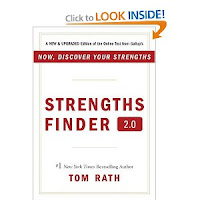 Does this sound like positive humanism - it does because it is. But that's because God has a much more positive view of our humanity and our role in his plan as humans than any of us could ever imagine. One theme that this blog will consistently draw from is that "God does not want to circumvent Creation, humanity and the institutions cultivated by humanity to accomplish his purposes." This does not mean that miracles are not true but that miracles are an intervention into God's natural cultivation of humanity, not a normative or an ideal function of how God wants to work.
Next time we'll talk about the groundbreaking book and why this idea from a non-Christian author is so Christ-like.
"Strengthfinders" - the thesis...
"From the cradle to the cubicle, we devote more time to fixing our shortcomings than to developing our strengths."
Recently, a movement called, Positive Psychology has critiqued this approach. Instead of basing one's prognosis of an individual on the DSM (Diagnostic and Statistic Manual of Mental Disorders), a prognosis would be based upon the CSV (Character Strengths and Virtues handbook) and then the DSM could be consulted for a balanced approach.

So what does that have to do with Confirmation and Affirmation. Most who grow up in a faith tradition look to God for "direction" or "confirmation" in their decision making. This isn't wrong for certain stages of growth in one's journey. In fact there doesn't need to be a battle between the options.
The pattern we need to look for moves from "Direction," to "Confirmation" to "Affirmation" which then gives the individual in question the ability to eventually give others "Direction," "Confirmation" and "Affirmation."
When we are making decisions that we are praying about, it seems that God works predominantly in each of those categories through different stages in one's life. It starts early in life with "Direction" (Direct supervision and decision making on behalf of the individual by God), then moves to "Confirmation" (God's final stamp of authority on decisions initiated by us), and finally to "Affirmation" (God's affirmative nod to decisions initiated, made and qualified by our growth in wisdom).
The predominance of each category throughout stages of our life doesn't exclude the influence of the other two categories. For instance, if I am at the stage where "Confirmation" is predominant, there will still be decisions that I need to make out of direct obedience (Direction) or out of Wisdom (Affirmation) but they will be fewer than those initiated by me and "Confirmed" by God (Confirmation).
"Jordan walks up to the counter, gives the cashier his items to purchase and a $20 bill. The items ring up as $13.57. The cashier bags the items and hands Jordan $15.43 in change. Instead of handing Jordan a $5 bill and a $1 bill he hands him a $5 and $10 bill. Jordan walks outside throws the items in his backseat and notices that there is a $10 bill instead of $1 bill in his hand. His choice is to take it back or pocket it. The dilemma begins. Jordan is 30 years old, has a job and isn't in need of extra money but wonders if the difference of $9 dollars really makes a difference. 15 years earlier as a 15 year old, he would have struggled immensely with what decision to make but he has consistently made the decision to take the money back over time and now he immediately returns the difference to the cashier and drives off without a second thought about it."
"God is watching over this whole process of decision making and remembers the day when he had to intervene through his Spirit to nudge, push and sometimes drag Jordan towards the right decision. He smiles and nods affirmatively, looking forward to this growing partnership with Jordan in establishing his kingdom on earth as Jordan drives away. Jordan's decision at the age of 30 reflects the 'Affirmation' stage of decision making, while his decision at the age of 15, when it was more of a dilemma and struggle to make the same decision, was more in the 'Direction' or 'Confirmation' stage of maturity. Now God begins the work of nudging Jordan to work with others who are struggling with their maturity and knows more and more that he can trust Jordan and consequently entrust others to Jordan."
How does this process of maturity relate to Positive Psychology? Well, we need to be aware of our strengths and weaknesses. Usually we focus on one more than the other and either turn into selfish narcissists or depressed masochists (extreme, I know). By balancing the awareness of our pathologies and weaknesses with the awareness and cultivation of our Strengths, Character and Virtues, we are able to overwhelm the desire to make destructive decisions. It is unhealthy to be so aware of your weaknesses and yet ignore your strengths or so aware of your strengths and ignore your weaknesses. If we hold them in tension, we are able to mature. We are able to move through the three stages of decision making at a rate that is healthy and normal. We are able to see our future in a positive light and make brave decisions based upon our strengths or realistic decisions based upon our limits.
 Does this sound like positive humanism - it does because it is. But that's because God has a much more positive view of our humanity and our role in his plan as humans than any of us could ever imagine. One theme that this blog will consistently draw from is that "God does not want to circumvent Creation, humanity and the institutions cultivated by humanity to accomplish his purposes." This does not mean that miracles are not true but that miracles are an intervention into God's natural cultivation of humanity, not a normative or an ideal function of how God wants to work.
 Next time we'll talk about the groundbreaking book and why this idea from a non-Christian author is so Christ-like.
"Strengthfinders" - the thesis...
"From the cradle to the cubicle, we devote more time to fixing our shortcomings than to developing our strengths."
Tuesday, March 30, 2010
3 Quotes and a Poster

"Without somehow destroying me in the process, how could God reveal himself in a way that would leave no room for doubt? If there were no room for doubt, there would be no room for me." --Frederick Buechner
"Propaganda makes up our minds for us, but in such a way that it leaves us the sense of pride and satisfaction of men who have made up their own minds. And in the last analysis, propaganda achieves this effect because we want it to." --Thomas Merton
"Question with boldness even the existence of God; because, if there be one, he must more approve of the homage of reason than that of blindfolded fear." --Thomas Jefferson
Sunday, February 21, 2010
Memory Loss
Dignity
We are called to restore it especially if it has been historically taken from other human beings by people who identify themselves as Christians.
Colonialism

What if God's mission for us was that we would co-operate in redeeming what had been destroyed, stolen, raped, disregarded, abused, used, etc...
I love walking down the streets of London and seeing how beautiful they are. Why are they beautiful - because the streets of Lagos, Nigeria are not. In America, why does the south have so many beautiful homes, with long drives overcast with gorgeous weeping willows - because the homes on the coasts of West Africa were emptied and the ocean floor was filled with dead bodies from here to there. I recently was given a picture of a plantation in the south as a decorative piece for my home. That picture will never be on the walls of my home.
What if our role as those who follow Christ was to come alongside cultures that have been lost to colonialistic and imperialistic impulses of stronger nations - to help re-discover where their true cultural identity actually is. This could be done imperialistically as well so great care and sensitivity would need to be present. What if that were the case? That that's how we as the church were to serve other nations in a post-colonial era? Does that sound colonial in and of itself?
God help us.
Redeem

We are called to restore it especially if it has been historically taken from other human beings by people who identify themselves as Christians.
Colonialism

What if God's mission for us was that we would co-operate in redeeming what had been destroyed, stolen, raped, disregarded, abused, used, etc...
I love walking down the streets of London and seeing how beautiful they are. Why are they beautiful - because the streets of Lagos, Nigeria are not. In America, why does the south have so many beautiful homes, with long drives overcast with gorgeous weeping willows - because the homes on the coasts of West Africa were emptied and the ocean floor was filled with dead bodies from here to there. I recently was given a picture of a plantation in the south as a decorative piece for my home. That picture will never be on the walls of my home.
What if our role as those who follow Christ was to come alongside cultures that have been lost to colonialistic and imperialistic impulses of stronger nations - to help re-discover where their true cultural identity actually is. This could be done imperialistically as well so great care and sensitivity would need to be present. What if that were the case? That that's how we as the church were to serve other nations in a post-colonial era? Does that sound colonial in and of itself?
God help us.
Redeem

Friday, February 19, 2010
Faith, Science and Agnosticism

In a discussion on Facebook I recently wrote this in response to the question about what our favorite presuppositions are. My friend, Joe said,
"So, I have to identify my most basic presuppostion that governs my worldview...I think its this: "An absolutely true reality exists and is objectively knowable". What's your favorite presupposition?"
One of my responses was,
"Joe - is it possible to maintain the first half of your presupposition and accept the second half in faith and ongoing discovery. There is a view I hold to in that regard called Confessional Realism. It is much like Critical Realism which is a view held by N.T. Wright, Paul Hiebert among others. Basically, the world does make sense, spirituality... See more, science, physics, emotions, etc... all line up and have always lined up without question but based upon our inabilities, infantilities and finitude, we can't see how that works as of yet. The responses vary from the escape into fundamentalist faith or to sola science or agreeable agnosticism. The choice that I've made thus far is Confessional Realism. This basically posits that the world functions as a whole and we are the ones that dissect it and then take positions against each other based upon our view of what is more important to us and how we integrate that arena of thought or discipline in our identity. This is not how God planned us to form our identity - by what the reality of the world is but at the same time we can discover some of his reality through the natural world. Either way, the integrated network of everything is available to us and as Christians we are the most apt to discover those connections but are unable because it might require learning something from someone else that would loosen our faith fidelity. Regardless, all disciplines have a connection to all other disciplines. If we want it to work like that, then we are called to discover and journey towards those connections and not to stop on and build a moat around our first discoveries. Realism posits that there is much more to discover. Given the categories that Christians can have that non-Christians don't have and vice versa, we are holding each other back. The difference is that our side requires a bit more of direct submission to a Person rather than an idea. That is the issue - spiritual knowledge (I Cor. 3) has more to do with categories of belief that unbelievers won't accept because to do so would require submission to the Persons of the Trinity. not an easy thing to do on a relational level unless you have been reached by the Holy Spirit.
It seems it would be best to accept the three different positions - fidel faith, sola science and agreeable agnosticism. In one way we accept the reality of the world, God and his sovereignty through faith while at the same time embracing the freedom and joy of scientific discovery and how that continues to coincide with our discoveries of God. This is going on while at the same time humbly believing through a lens of agnosticism that holds our own contextual situatedness in check. There have to be check and balances for each position and each one does well to listen to the other so we don't end up burning people for believing that the the universe is heliocentric or put people in jail for having anti-government hymn sings or revile those who actually want to take a stand instead of maintaining a neutral and ultimately unjust lifestyle. I wonder what your thoughts would be."
I do wonder!
Tuesday, February 16, 2010
Eating for Two

I have a friend who experienced really bad "winds" for awhile in his adult life. He didn't really think it was a problem (as in it shouldn't have happened as much as it did) until he got married. His and his wife decided to go on a detox diet and cut everything out of their diet that causes abnormal "winds." They began slowly adding the items to their daily diet that had been removed and discovered that it was actually the dairy products that were causing the problems. All his life my friend had loved dairy and had eaten it without concern and never thought it would be connected to his "winds." What was most interesting to me was the process that they had to do in order to first cleanse themselves and then move to rebuild their diet to recognize what was harming them. I guess he would have hoped it was something that he was impartial towards or at the least an expensive and largely unavailable item that he wouldn't really need anyways (I'm sure he was hoping for cheap beer to come up as the culprit, leaving no choice but to buy the good stuff), but alas, it was the dairy one of his favorites. Now dairy is not bad for others and in fact it is very good, especially for those who are developing physically. Although some cultures can handle a lot less than others.
Lately, I have been "detoxing" from Christianity. Not necessarily historic Christianity but our cultural, Western, Evangelical, church culture Christianity. I have cut back the diet (i.e. Quiet time, church, Christian music and radio, churchianity, Christianese, doctrines handed to me sealed in earth destroying plastic and made somewhere else or in someone else's context, etc...). I have trimmed my portions. Many may believe me to be back-sliding while others will just dismiss it as a phase. I feel like it is more what my friend was doing. At one time, dairy was very important for his development, but eventually when he became an adult, it became toxic for his body to ingest as much or more as he had always eaten. In many ways, the structures, systems, patterns of discipleship and general ethos of the "general" culture of Christianity can only sustain a certain segment of those on their faith journey while to others it will become toxic at some point and actually begin to cause illness rather than growth.
Paul speak about this in his letters as well as the author of Hebrews in the New Testament. There is a need to move on from milk to solid food. What the text doesn't mention (though not out of negligence) is that the milk, if it is maintained in the diet, can actually be harmful and toxic to the over all health and well-being of the individual as they continue to grow. This isn't true for all people but lactose intolerance is enough of an issue globally that it could be recognized. This is not the point I'm hoping to draw as much as it illustrates that those patterns which at one point were extremely necessary and beneficial to us in our spiritual maturing process have a shelf life and need to mature into different patterns that match our growth patterns, as individuals, as communities, and as the church universal as we mature towards the consummation of all things.
To identify the problem I have to at some level critique different traditions. I don't want to focus on one tradition in this post but rather recognize the frailty of some of the evangelical impulses for faith development.
"Quiet time" - spending an hour a day with God. What kind of formative function does that play in the life of a 15 year old versus a 50 year old?
"Emotional, introspective worship music" - how does that give opportunity for expression for a 15 year old versus a 50 year old?
"Christian Sub-Culture" - how does that inform an 15 year old versus a 50 year old about the need to engage culture in the wider world.
The list goes on and on. What we have been told to do many times is right for someone else but not for us. This is not because we're simply postmoderns but because the dismissal of blaming this complex issue on an epistemology like postmodernity totally misses the emotional and developmental components of how people develop. It is literally a cop out. On issues of morality, there are some things that would be immoral for a 15 year old to engage in and not a 50 year old - i.e. drinking alcohol or sexual intimacy. There is a context for these and morality is situational for certain things but of course not for all.
I'm frustrated by the act of normalizing a function of maturity and then codifying its practice as normative for all Christians everywhere at all times. It has been healthy and eye-opening not to go to church as well as it has been to go to church. It has been refreshing to not have a "quiet time" but to engage God in one's own time that is more relationally based rather than militaristic. Why is the discipline needed - it is of course for the our own benefit but discipline and codification and regiments given by others for our benefit also need the space to be discontinued if they are not fit for the individual or community practicing them. Some spiritual practices or experiences given to us are actually fluff and only offer short term pay offs but long term frustration. I could eat pizza every day and drink a gallon of milk a day when I was 15, but if I did that now - whoa - the repercussions would be enormous.
Discernment, maturity and spiritual growth lead us to realize that there are few things we can understand comprehensively but there are many aspects to our growth that we have to be ready for that we have not encountered yet. These new plateaus of learning which we have never seen before may require some things of us that weren't required before. At the same time they may require us to shed some things that we have held dear to us and have given us much comfort, security and legitimate transformational experiences. This of course doesn't mean that we never do what was done before but it does mean changing our diet for the better. What we once loved may now be hurting us. We may have to stop drinking milk.
Wednesday, January 27, 2010
A rant againt Convention
Lord deliver me
from a life of balance
A Presumptuous idle
an act of violence
Let me honor the land
that feeds me
And only bite it if
it tries to squeeze me
-Nathan
from a life of balance
A Presumptuous idle
an act of violence
Let me honor the land
that feeds me
And only bite it if
it tries to squeeze me
-Nathan
Tuesday, November 17, 2009
To cruise or not to cruise part 1

Recently, my wife and I went on a 4 day cruise with Royal Caribbean Cruise lines. We had no idea what it was going to be like and as we boarded the ship and took our first look at the lunch menu - we knew we were in for a treat. At that moment, we both thought out loud, "wow - this would be so fun to share with some really good friends or our families." I guess that was the honeymoon because as the weekend went on, there were more and more aspects that began to bother me. Don't get me wrong - we enjoyed ourselves a lot. The frustrations came as each day unveiled the personality of cruising. More on this later!
Wednesday, October 21, 2009
Creation is our Domain, not humanity, time or Deity
“Scratch any of us and you will find we are witch doctors underneath.”
- Dr. Paul Hiebert.
The temptation for man is to control that which we are to submit to, cooperate with, regenerate, mentor and love.
We have the responsibility,
1. to have authority over Creation in order to steward Creation,
2. to cooperate with, mutually submit to, regenerate, mentor and love humanity,
3. to cooperate with and submit to time and
4. to submit to, cooperate with, give worship to and love the Trinity.
This is the order of how worship towards God is to be ordered. We worship Him based upon responsibility, authority, submission, love and cooperation.
Fearful manipulation, bitter jealousy, selfish ambition and hateful anger are the destroyers of this order.
Cain and Abel experienced this dynamic - the first murder was a result of the above list.
The first rebellion was acted out in the context of sinlessness, yet with self-deceit. Our role today knows no such context. Our context knows only sin and selfishness therefore, to sin is natural and to do so requires that we accept that our starting point with worship, responsibility, submission, love, authority and cooperation is to do the exact opposite. Therefore ordering our worship to God according to these categories will allow the alignment of our holistically rebellious hearts back towards what is true, life-giving and founded in Eden though oriented towards the New Creation.
- Dr. Paul Hiebert.
The temptation for man is to control that which we are to submit to, cooperate with, regenerate, mentor and love.
We have the responsibility,
1. to have authority over Creation in order to steward Creation,
2. to cooperate with, mutually submit to, regenerate, mentor and love humanity,
3. to cooperate with and submit to time and
4. to submit to, cooperate with, give worship to and love the Trinity.
This is the order of how worship towards God is to be ordered. We worship Him based upon responsibility, authority, submission, love and cooperation.
Fearful manipulation, bitter jealousy, selfish ambition and hateful anger are the destroyers of this order.
Cain and Abel experienced this dynamic - the first murder was a result of the above list.
The first rebellion was acted out in the context of sinlessness, yet with self-deceit. Our role today knows no such context. Our context knows only sin and selfishness therefore, to sin is natural and to do so requires that we accept that our starting point with worship, responsibility, submission, love, authority and cooperation is to do the exact opposite. Therefore ordering our worship to God according to these categories will allow the alignment of our holistically rebellious hearts back towards what is true, life-giving and founded in Eden though oriented towards the New Creation.
under the sun
Some say there is nothing new under the sun,
New
Anew
Renew.
How do we deal with the semantics/meanings of these words if there is nothing new. Wouldn't that cause these words to be rendered meaningless. Or is it that whatever is "new" can only be new to my senses, from my situatedness, from my perspective in its inherent limited spector.
I have to believe that the word "new" has a rendering that cannot be contained or exhausted by our intuition, knowledge, educational investments, experience, etc... Nothing is new to God as we understand him, but our ability to apprehend knowledge and awareness of what is true or real will never be exhausted - which requires that our experience of truth has to be new - some of it granted will have been discovered by others long before us but there has to be some room for things that have never been discovered before by human beings - this can be historically substantiated over and over.
For me the approach needs to come through three terms that use the root of "new" in English. This is not an exhaustive explanation conceptually and the limitations of English are always present but here goes...
New - of recent origin, production, purchase, etc.; having but lately come or been brought into being: We use this term to speak of brand new, unusual, fresh or recent aspects of description.
Anew - in a new form or manner: This is where things, ideas, experiences, explanations, etc... are re-discovered in a given context that had not previously had the aspect spoken of in the current context. We can then re-discover anew in a way that brings a new awareness.
Renew - to be restored to a former state; become new or as if new again: this term best represents the process of things becoming new. As there are very few brand new and completely fresh ideas or sources of knowledge, most of our understanding that is new is really a renewed understanding of things that already exist. Many times our new discoveries depend upon the conceptual framework that already exists in our hearts, minds and actions. We discover new things through what we already understand and know generally. Those things may have already been discovered, but there has to be somethings that are unique and new apart from discoveries that are already present in the up-to-date general human consciousness. This can point to the assurance that to God - nothing is new under sun from his perspective but to us, many things will be new under the sun and some of them will be brand new but not necessarily independently new from our former frameworks.
Newness is life - Mercy is new every morning - there is new life - new things will be done and the things of old will be forgotten.
There are many things new under the sun.
New
Anew
Renew.
How do we deal with the semantics/meanings of these words if there is nothing new. Wouldn't that cause these words to be rendered meaningless. Or is it that whatever is "new" can only be new to my senses, from my situatedness, from my perspective in its inherent limited spector.
I have to believe that the word "new" has a rendering that cannot be contained or exhausted by our intuition, knowledge, educational investments, experience, etc... Nothing is new to God as we understand him, but our ability to apprehend knowledge and awareness of what is true or real will never be exhausted - which requires that our experience of truth has to be new - some of it granted will have been discovered by others long before us but there has to be some room for things that have never been discovered before by human beings - this can be historically substantiated over and over.
For me the approach needs to come through three terms that use the root of "new" in English. This is not an exhaustive explanation conceptually and the limitations of English are always present but here goes...
New - of recent origin, production, purchase, etc.; having but lately come or been brought into being: We use this term to speak of brand new, unusual, fresh or recent aspects of description.
Anew - in a new form or manner: This is where things, ideas, experiences, explanations, etc... are re-discovered in a given context that had not previously had the aspect spoken of in the current context. We can then re-discover anew in a way that brings a new awareness.
Renew - to be restored to a former state; become new or as if new again: this term best represents the process of things becoming new. As there are very few brand new and completely fresh ideas or sources of knowledge, most of our understanding that is new is really a renewed understanding of things that already exist. Many times our new discoveries depend upon the conceptual framework that already exists in our hearts, minds and actions. We discover new things through what we already understand and know generally. Those things may have already been discovered, but there has to be somethings that are unique and new apart from discoveries that are already present in the up-to-date general human consciousness. This can point to the assurance that to God - nothing is new under sun from his perspective but to us, many things will be new under the sun and some of them will be brand new but not necessarily independently new from our former frameworks.
Newness is life - Mercy is new every morning - there is new life - new things will be done and the things of old will be forgotten.
There are many things new under the sun.
Monday, October 19, 2009
proportional empowerment and dis-empowerment

I believe there is a direct proportion of dis-empowerment from the clergy to the empowerment of the laity in churches and faith communities these days. The opposite is also true it seems. It would seem that this is why Christ displayed a model that made him as equal to those he was discipling as was divinely possible. This doesn't mean that he was trying to exact himself in human form so as to keep his divinity undetected. It is more that he was unassuming in his "leadership" ability and didn't extend himself on his own account other than through miracles and his declared relationship to the Father. He had no problem displaying obvious authority over the elements (walking on water, stilling the storm), angels (fallen or not), the law (Sabbath), the body and sickness (healings and raising from the dead) and over himself (self control, sinlessness). In doing so he modeled for us the authority that he was to pass on to us. We have that authority, though imperfectly and not as fully expressed as he did, but nonetheless, the design is that we would carry the same authority throughout Creation according to our relationship with him over his creation as stewards and co-creators and members of his redemption team.
He could have become a Scribe with his knowledge of the Law and he could have become famous with his ability to heal and do miracles of all sorts but he hid that. What is interesting is that he was consistently intentional about withholding his divine attributes in order to be fully human - not fully human in the way that we are fully human but fully human in the way that we are to become fully human. The potential to be fully human is present within us but can only be unleashed and fully expressed in a living relationship with Christ. The fullness of that expression can then only be experienced in the new creation - but that which is necessarily possible within us is also essentially us now in our identity (positional justification/already not yet).
One can track with this line of thinking by accepting that Christ's life is just as important as his death and resurrection because in it, that is his life - redemption was also present. Not necessarily redemption that he accomplished through the cross, but the redemption principles that we would learn from his life and then carry into our life - the life and action of his body, the church. This would be our modus operandi as his community until he would return.

He was constantly giving away power, prestige and opportunities to be praised. He either gave them to his disciples, to his Father or he would tell the onlookers to not speak a word of what he had done. In our time, he has given them to the church. So as the life of Christ, as 100% human, is the model that we are called to live under, we then have the ability and potential for everything that he accomplished except for substitutionary atonement.
One question is, is it possible for human beings to calm a storm? Was Christ doing that to nature or was he rebuking an invisible enemy. Some believe it is possible that he was actually rebuking the enemy who was causing the storm, otherwise a rebuke wouldn't have been needed. In other circumstances where natural phenomena occurs in a supernatural way, there is no need for a rebuke. A rebuke is language generally reserved for the enemy of our souls not for nature. It is obvious in the text that the disciples thought he was addressing nature in his remark but the facts remain and it is still possible that he was addressing evil spirits who were also able to cause the conditions that they were in.
Either way, the idea that Christ gave away power through his example and the way in which he discipled, lived, taught, healed, etc... is seemingly strong. His efforts were to "em-power" the disciples. As we see with Christ and the Pharisees, the message given by Christ of the New Covenant arriving and his identity as the Messiah who had brought it, was definitely not welcome. The disciples already doubted their purpose, ability and place in Jewish society as it pertained to their backgrounds (Christ never chose a Pharisee, Saducee or Essene to join him - only misfits, socially uneducated and unacceptable, non-conformists, outcasts and compromisers). It would follow that they would struggle to also embrace their God given identity as heralds of "the" New Covenant and the message of "the" Messiah who had come and gone. Not an easy task in their environment and historical setting. His constant affirmation of them from the first time he chose them to the final commission he gave them at his ascension and every affirmation in-between shows how intentional he was about always giving away power and purpose, affirmation and authority - even to those who seemed least likely to manage it well. But over time they got it and became 12 of the most unstoppable characters in the history of the church.
Therefore through Christ's example and life we can say that, "there is a direct proportion of dis-empowerment from the clergy to the empowerment of the laity in churches and faith communities in the establishment and growth of those communities and the church as a whole universal. There is also a proportionate movement of empowerment of the clergy with a resulting dis-empowerment of the laity in the opposite direction that is also true."

Christ's example was not only through humility in the washing of the disciples' feet but also in power and authority in the elevation of their apostolic identity and purpose in spreading the "gospel" globally, regionally and locally. If the responsibility in the Great Commission is as pervasive as it is reported to be in Matthew 28, then the authority to accomplish that great commission has to match the responsibility and any good parent, leader, manager or trainer will tell you and also model for you that responsibility and authority are better caught rather than just taught. Ultimately, to do what Christ commissioned us to do requires a continual affirmation and em-powerment of regular people being equipped and empowered to accomplish irregular tasks - tasks that even Christ said would be greater than his.
Get Rich or Die Tryin'?

Lately I've been learning a lesson - to sow peace is wise because over the long haul, it reaps a harvest of righteousness which seems to be the fruit of what we know as a redemptive heritage that builds the Kingdom over time.
I really like to see results from my visions, dreams and actions sooner that they are designed to be achieved. By pushing forward with selfish ambition because of jealousy and envy that leads to impatience, I forego the plan of God for my life and for the way that my life is to minister and serve the lives I'm connected to directly or indirectly. The way we live is designed to outlast our actual life. That "way" can either be redemptive, creative, life-giving and beautiful or it can be destructive, utilitarian, impatient and life-diminishing.
If I constantly keep in my heart and head and hands the practice of sowing peace in all my situations of life, easy, difficult or indifferent, I will over time see a harvest of shalom and fullness. This will have to cost me something and at times things and valued treasures that are dear to me, but the outcome will be worth it all. In one sense then, the concept of living our lives based on results can actually be good if those results are not according to our terms, time-frame or quantitative/qualitative controls. If we were to live for results that outlived us that gave life, brought light to darkness, truth to deception and redemption to hopelessness, then it would be ethical to live according to the results. The paremeters for measuring those results obviously would be much different than our current culture tells us. The interesting thing is that many times, the culture shaping corpus's that we look to and are fed by - the media, strong personalities, itching ear teachers, economic systems of control and wealth, religious platforms, political ideals and the like - many times their intentions and preached messages are actually redemptive but their hearts and the methods, structures and lived ethics that they actually employ don't match up. I am the same in my personal life.
I want what's best for my family, me and the people that God has given me to care for and be cared for by but there is a disconnect between what I do each day and what I "think" and "say" to establish my sense of ethical responsibility and an ensuing lifestyle to match.
James says, "...And a harvest of righteousness is sown in peace by those who make peace."
In the Message, it says it like this, "You can develop a healthy, robust community that lives right with God and enjoy its results only if you do the hard work of getting along withe each other, treating each other with dignity and honor."
I have learned that in spite of my desire to want what's right, I try to achieve it combatively at times when an attitude of patience and peace-making is a better path. My personality doesn't shy away from conflict and at times looks for it to solve problems. This can be good when stuff needs to come to the surface that has been simmering below the surface for too long but many things that simmmer just need to have the burner shut off. That is not natural to my consciousness and I have seen that no matter what the issue is - large or small, that i tend to be ready to resolve most problems head on in full force, when many issues are better left alone. Sowing peace in my life looks a lot like avoiding the first punch at a problem and seeking the shalom of a community rather than being the first one in line to critique, condemn, catalyze the issue or conflate an issue pasts its necessary limits. I'm very judicial at times and as a result have little room for grace and patience.
The flip side is that there are some who do everything they can to avoid conflict and brush issues under the carpet or have many simmering pots full of issues that have rarely been dealt with which makes for a lot of simmering pots and a lot of collective heat, ready to be let off at an untimely place and in an untimely manner.
I guess both types of people struggle to sow peace. My type wants to deal directly and scare up the issue asap - to "nip it in the bud" as they say whereas the other side doesn't nip anything in the bud and weeds begin to take over the life of the garden. Either way, both approaches do not seek to sow peace. Sometimes peace being sown means letting an issue go and giving grace while at other times it means letting an issue come to the surface and facing it with courage. These are difficult patterns of community life and probably the most difficult over time. Though in time, James tells us that if we continually (not perfectly) sow peace, then a harvest of right relationships and many other right things will result.
There's always space for some weeds in the garden yet, if there are two many weeds then it is no longer a garden.
Jesus told them another parable: "The kingdom of heaven is like a man who sowed good seed in his field. But while everyone was sleeping, his enemy came and sowed weeds among the wheat, and went away. When the wheat sprouted and formed heads, then the weeds also appeared.
"The owner's servants came to him and said, 'Sir, didn't you sow good seed in your field? Where then did the weeds come from?'
" 'An enemy did this,' he replied.
"The servants asked him, 'Do you want us to go and pull them up?'
" 'No,' he answered, 'because while you are pulling the weeds, you may root up the wheat with them. Let both grow together until the harvest. At that time I will tell the harvesters: First collect the weeds and tie them in bundles to be burned; then gather the wheat and bring it into my barn.' " (Matt. 13:24-30)
This parable doesn't seem to line up exactly with what I'm learning yet the characteristics of taking on a problem that has come up seem to be very similar with the conclusion that James was writing with in his third chapter.
James notes,
"Real wisdom, God's wisdom, begins with a holy life and is characterized by getting along with others. It is gentle and reasonable, overflowing with mercy and blessings, not hot one day and cold the next, not two-faced. You can develop a healthy, robust community that lives right with God and enjoy its results only if you do the hard work of getting along with each other, treating each other with dignity and honor."
So it looks like we always come back to wisdom. Wisdom seems to always say something more and deeper and beyond our first thoughts and feelings in most situations. I know that I'm not afraid of conflict and conflict resolution but the path that I "viscerally" or "naturally" take to get there many times works against the very resolution that I'm seeking. It's more painful to wait, listen seek the path of wisdom in dealing with conflict which may or may not require what one feels or sense first. Whatever I feel, think or sense is the right thing to do, I have begun to ask myself two questions,
"Am I sowing seeds of peace?"
"What would wisdom do?"
I like asking what would wisdom do instead of what Jesus would do? I find it difficult to critique my own sense of ethics and whether I'm able to be true to the truth when I'm asking what Jesus would do. Many, including myself, find it easier to cast Jesus in our own image and refer to the aspects of his actions and personality that fit with our actions and personalities - we then can easily ask - WWJD?
I barely know the guy and yet I've been with him for years. Not knowing him well enough and the frustration with not knowing what he would actually do in a given situation drives me to an impatient appraisal of who I think he is. I then speak of him doing what I would really do - and I can do all of this without even thinking about it. Then I parade Jesus' name and reputation around to other people to show them why I'm right and ethical in my actions.
WWJD is designed to hurt us and discomfort us (though at times it can comfort) more than to confirm our imposed personal ethics or to allay our fears of being wrong. So I find it more realistic and safer to ask, what would wisdom do. This doesn't circumvent Christ but allows us to see him in the context of wisdom, as he is our wisdom from God according to Scripture. I think we can all freely admit we need a lot of growth in wisdom. If Christ is our wisdom then he retains the ability to lead us to wisdom and to embody wisdom and its implications for difficult decisions. In this we do not look past Christ to Wisdom but look to wisdom as a paradigm through which Christ lived ethically and obediently to the Father.
Consistently asking these questions and then doing the hard work of listening to the answers and not just asking the questions, has a promise - a harvest of right relationships and a bunch of other... right things.
-Nathan Smith (inspiration from humiliation)
Thursday, January 08, 2009
Beauty
"Before the beautiful—no, not really before but within the beautiful—the whole person quivers. He not only 'finds' the beautiful moving; rather, he experiences himself as being moved and possessed by it."
-Hans Urs von Balthasar
-Hans Urs von Balthasar
Tuesday, December 09, 2008
“To buy or not to buy, a miscarriage of hope”
I walk on water, a sea of broken glass and grace
Peering down for a misty reflection
Of eyes that have seen her face
Lingering in a room that still has her taste
Her scent now overgrown
A memory holding my hand but I’m still alone
Calling back a love that’s out on loan
Everyone else holding what once was my own
Maybe we were never meant to be this close
Too much of one ingredient
Makes for a lethal but lengthy dose
Cast down eyes filled with remorse
Abortion reeks of choices made
But miscarriages end life a little too late
Instead , it’s just a rescue rope frayed,
A song written but never played
Why begin at all to only begin again?
Not able to even call her a friend
Unable to rescue what’s been lost
Spring fruit now covered by the frost
It really sucks when it doesn’t make sense
And I’m sure you’re not asking for my two pence
But it’s wrong when what makes sense only dies
Slowly but surely right in front of your eyes
Some say goodbye and it goes away
Some say hello and it stays another day
Wishing this didn’t happen but also for one more day
But I know it’s a day that’s long gone, so leave me alone okay
Some ask if I would change a thing
A hushed pause, and I breathe “no”
I’m only weary of the question
And the miscarriage of hope.
Tomorrow I’ll wake and for one moment forget
It’ll be nice, I’m sure, I’ll bet
But where were you my dear forgotten thought
When in a moment I get to drown in the choices I have bought.
A miscarriage speaks of a world we’ll never know
Somebody break the hourglass so that time will finally be old.
A miscarriage speaks of a world so alive and full
A safe place – where time can’t take from us what we were supposed to hold
Peering down for a misty reflection
Of eyes that have seen her face
Lingering in a room that still has her taste
Her scent now overgrown
A memory holding my hand but I’m still alone
Calling back a love that’s out on loan
Everyone else holding what once was my own
Maybe we were never meant to be this close
Too much of one ingredient
Makes for a lethal but lengthy dose
Cast down eyes filled with remorse
Abortion reeks of choices made
But miscarriages end life a little too late
Instead , it’s just a rescue rope frayed,
A song written but never played
Why begin at all to only begin again?
Not able to even call her a friend
Unable to rescue what’s been lost
Spring fruit now covered by the frost
It really sucks when it doesn’t make sense
And I’m sure you’re not asking for my two pence
But it’s wrong when what makes sense only dies
Slowly but surely right in front of your eyes
Some say goodbye and it goes away
Some say hello and it stays another day
Wishing this didn’t happen but also for one more day
But I know it’s a day that’s long gone, so leave me alone okay
Some ask if I would change a thing
A hushed pause, and I breathe “no”
I’m only weary of the question
And the miscarriage of hope.
Tomorrow I’ll wake and for one moment forget
It’ll be nice, I’m sure, I’ll bet
But where were you my dear forgotten thought
When in a moment I get to drown in the choices I have bought.
A miscarriage speaks of a world we’ll never know
Somebody break the hourglass so that time will finally be old.
A miscarriage speaks of a world so alive and full
A safe place – where time can’t take from us what we were supposed to hold
Miscarried
I knew a love once
With whom I almost married
Her eyes were like magic
But then our love miscarried
Was it meant to be?
I don’t like to ask that question
I just know it was right
She was a friend, and the best one
All the beautiful pieces
Fit together like rain
Pouring down this mountain
And then - down a drain
Why does it come
With such force and such beauty?
Then slip from our hands
Deep desire turning to duty
We knew it should last
Forever and then some more
But it dropped out of school
And made the sound of slamming door
We should’ve taken it home
Into it’s room nice and warm
But it bled out of our souls
And then it joined the unborn
I knew a love once
With whom I almost married
Her laughter was my sunshine
But then our love miscarried.
We threw caution to the wind
So some said our love was premature
I don’t care what they say
They were wrong and just a little too sure
Don’t expect me to believe them
Or shop at their store
Because everything they were selling
Just made me want more
I don’t know why it happened
Why my heart closed the door
I know it wanted to open
Free to dance and to explore
Was it the safest place
To hurt this much?
Why does He let us love
Only to hand us a crutch?
Now her hand has slipped from mine
Maybe on to another man
He might be good for her
Maybe a lot more sublime
All I know is that I once knew a love
With whom I almost married
She brought me back to life
But then our love miscarried
A heart deep with riches
And hurt I cannot soothe
Our love really did miscarry,
And I’ll never know what I really did lose
With whom I almost married
Her eyes were like magic
But then our love miscarried
Was it meant to be?
I don’t like to ask that question
I just know it was right
She was a friend, and the best one
All the beautiful pieces
Fit together like rain
Pouring down this mountain
And then - down a drain
Why does it come
With such force and such beauty?
Then slip from our hands
Deep desire turning to duty
We knew it should last
Forever and then some more
But it dropped out of school
And made the sound of slamming door
We should’ve taken it home
Into it’s room nice and warm
But it bled out of our souls
And then it joined the unborn
I knew a love once
With whom I almost married
Her laughter was my sunshine
But then our love miscarried.
We threw caution to the wind
So some said our love was premature
I don’t care what they say
They were wrong and just a little too sure
Don’t expect me to believe them
Or shop at their store
Because everything they were selling
Just made me want more
I don’t know why it happened
Why my heart closed the door
I know it wanted to open
Free to dance and to explore
Was it the safest place
To hurt this much?
Why does He let us love
Only to hand us a crutch?
Now her hand has slipped from mine
Maybe on to another man
He might be good for her
Maybe a lot more sublime
All I know is that I once knew a love
With whom I almost married
She brought me back to life
But then our love miscarried
A heart deep with riches
And hurt I cannot soothe
Our love really did miscarry,
And I’ll never know what I really did lose
Tuesday, December 02, 2008
David wins
I saw such a man sin so great
that he filled those around with so much hate
and then his heart broke with so much shame
He called to One who broke silence with his name
I saw a woman marry a man
they hadn't kissed or caressed until they clasped hands
Friends cheering them on like game day fans
all because they had stuck to the plan
I saw a woman pregnant and in love
she held his hand and he held her white glove
Amazing Grace was their song while Eden stared past the loss
towards Heaven whose gaze always stares back past the cross
He resurrects the dead and dying cold
A simple breath to bring freedom to the sold
A gentle smile speaks a word so strong
A Shepherd's staff and arms that reach so long
Pleasing beauty, making things beautiful
All things received and nothing too old
Whatever you have, He'll take and then He'll give
Whatever you break, he'll re-make for a gift
Whatever you fake, he'll shake like a sieve
Whenever you scream, He'll whisper "I still live."
that he filled those around with so much hate
and then his heart broke with so much shame
He called to One who broke silence with his name
I saw a woman marry a man
they hadn't kissed or caressed until they clasped hands
Friends cheering them on like game day fans
all because they had stuck to the plan
I saw a woman pregnant and in love
she held his hand and he held her white glove
Amazing Grace was their song while Eden stared past the loss
towards Heaven whose gaze always stares back past the cross
He resurrects the dead and dying cold
A simple breath to bring freedom to the sold
A gentle smile speaks a word so strong
A Shepherd's staff and arms that reach so long
Pleasing beauty, making things beautiful
All things received and nothing too old
Whatever you have, He'll take and then He'll give
Whatever you break, he'll re-make for a gift
Whatever you fake, he'll shake like a sieve
Whenever you scream, He'll whisper "I still live."
It never ends
I hate losing what you love the most
where heartache becomes your only host
I hate life's lessons learned
When wisdom is your only return
I shake my fist at a forever sky
and wage war on battles that end in a tie
Losing is only half the battle
getting dragged by a horse instead of sitting on the saddle
I hate screwing up
for someone else to get down
I hate being upfront
just to see a row of frowns
It's easier to feel pain when you cut yourself
Instead of from someone else, those who have your heart's wealth
They say hope should finish every song
I say hope's a dirty word, even if it is wrong
I hate being jailed away from where I belong
All because I hurt the thing that makes my heart long
Keep it alive they say
let it grow to live another day
I say what about now?
What about today?
This rhyme doesn't have a good finish
because it never ends, it never goes away
where heartache becomes your only host
I hate life's lessons learned
When wisdom is your only return
I shake my fist at a forever sky
and wage war on battles that end in a tie
Losing is only half the battle
getting dragged by a horse instead of sitting on the saddle
I hate screwing up
for someone else to get down
I hate being upfront
just to see a row of frowns
It's easier to feel pain when you cut yourself
Instead of from someone else, those who have your heart's wealth
They say hope should finish every song
I say hope's a dirty word, even if it is wrong
I hate being jailed away from where I belong
All because I hurt the thing that makes my heart long
Keep it alive they say
let it grow to live another day
I say what about now?
What about today?
This rhyme doesn't have a good finish
because it never ends, it never goes away
Monday, December 01, 2008
Subscribe to:
Posts (Atom)